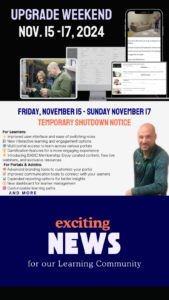
We’re thrilled to share that Learning Lever, our signature Digital Training Solution, is getting a series of exciting updates to make your experience more dynamic and user-friendly! Here are the essential details for the upgrade weekend:
Temporary Offline Period: Learning Lever will be offline from Friday, November 15th at 8 PM through Sunday, November 17th.
One-Time Login on Monday: When you log in on Monday, November 18th, you’ll just need to re-enter your email and password. Once saved, you’re all set!
Purchases and Support Available: While purchases won’t be available on the portal during the upgrade, our team is here to help! Contact us anytime at info@rtilearning.com for purchase questions or just to say hi.
During this time, we’ll be implementing updates designed to make learning management smoother, tools more powerful, and overall training even more enjoyable! Here’s what you can expect:
Key Upgrade Highlights
Enhanced Learning Experience: Discover new features that bring even more fun and functionality to your training journey.
Improved Learning Management Tools: Easily manage and track your progress with streamlined navigation and tools.
Updated Portal Interface: Our new design provides a clearer, more intuitive layout, making it easier to find what you need when you need it.
What to Expect When We’re Back
When Learning Lever returns on Monday, November 18th, simply log in with your email and password—just this once! After you re-enter your credentials, they’ll be saved, and you’re all set to explore the new features and enjoy an even better learning experience.
During the upgrade window, purchases won’t be available directly through the platform. But don’t worry—our team will be on standby all weekend! If you have any questions or need assistance with purchases, feel free to reach out at info@rtilearning.comor call at 610-926-0223. We’d love to hear from you!
Thank you for your patience and support as we work to make Learning Lever even better for our incredible community. Stay tuned, and we look forward to welcoming you back on Monday with a refreshed, upgraded platform!
We are thrilled to announce the launch of our new Tip Series, How to Get Your Team to Do the Thing!, in collaboration with C&R Magazine and The Language of Leadership. This series is designed to help you Run. Build. Achieve.—providing essential strategies to reduce frustration, build highly accountable teams, and create a positive work environment.
Why This Series Matters
Leadership in any business is about more than just giving orders—it’s about fostering a culture of engagement, accountability, and happiness. With insights from Erik Berglund, CEO and Founder of The Language of Leadership, we will share practical tips that empower you to motivate your team and achieve outstanding results.
Lisa Lavender, COO of Lever360, emphasizes the importance of these tips, stating, “This is the backbone to all the processes, SOPs, training, and all the other work and resources that go into building a scalable and efficient restoration company.”
Tip 1: Quality of Work Thing
Getting your team to consistently deliver high-quality work and follow through on their responsibilities is one of the biggest challenges leaders face. But with the right approach, you can make this process smoother and more effective. This week’s tip delves into how to motivate and inspire your team to take action and ensure that the quality of work remains high.
Take the Next Step: Master the Language of Leadership
Want to take your leadership skills to the next level? Join our FREE course, Introduction to the Language of Leadership, and learn the secrets to communicating more effectively with your team. This course is designed to give you the tools to lead with confidence, build stronger relationships, and inspire action.
Join the Academy: Practice Leadership in a Supportive Environment
For those ready to dive deeper and apply these lessons in real-time, the Language of Leadership Group Coaching Academy is the perfect place to practice and refine your skills. With hands-on coaching and personalized feedback, you’ll learn how to lead your team with confidence and clarity.
We are thrilled to announce the launch of our new Tip Series, How to Get Your Team to Do the Thing!, in collaboration with C&R Magazine and The Language of Leadership. This series is designed to help you Run. Build. Achieve.—providing essential strategies to reduce frustration, build highly accountable teams, and create a positive work environment.
Why This Series Matters
Leadership in any business is about more than just giving orders—it’s about fostering a culture of engagement, accountability, and happiness. With insights from Erik Berglund, CEO and Founder of The Language of Leadership, we will share practical tips that empower you to motivate your team and achieve outstanding results.
Lisa Lavender, COO of Lever360, emphasizes the importance of these tips, stating, “This is the backbone to all the processes, SOPs, training, and all the other work and resources that go into building a scalable and efficient restoration company.”
Tip 1: Quality of Work Thing
Getting your team to consistently deliver high-quality work and follow through on their responsibilities is one of the biggest challenges leaders face. But with the right approach, you can make this process smoother and more effective. This week’s tip delves into how to motivate and inspire your team to take action and ensure that the quality of work remains high.
Take the Next Step: Master the Language of Leadership
Want to take your leadership skills to the next level? Join our FREE course, Introduction to the Language of Leadership, and learn the secrets to communicating more effectively with your team. This course is designed to give you the tools to lead with confidence, build stronger relationships, and inspire action.
Join the Academy: Practice Leadership in a Supportive Environment
For those ready to dive deeper and apply these lessons in real-time, the Language of Leadership Group Coaching Academy is the perfect place to practice and refine your skills. With hands-on coaching and personalized feedback, you’ll learn how to lead your team with confidence and clarity.
The warehouse is a frustration for many with a vision of a clean and organized operation and production facility. Turning this dream into reality requires a deliberate action plan, a deadline, and buy-in from your employees.
You may have tried to mobilize Operation: Organize the Warehouse, or it may be on the “TO DO” list. Because there is never enough time, or space, in our restoration businesses, we need to plan, schedule, and make it happen. Described in the article, “Roll it Uphill – A Lesson in Leadership”, is the mindset of taking action and leading the way instead of placing blame on your team for the things that don’t get accomplished. Take the example of a new piece of expensive equipment that gets lost and forgotten in a messy collection of equipment, cords, and supplies. It happens all the time, right? What would be the result if the thought process was more of the following…
Does the new piece of equipment have a designated, labelled place where it belongs?
Did this designated place get communicated to the team?
Does the rest of your equipment and supplies have assigned shelf or floor space?
Do you currently have space capacity for additional equipment? Might it have been better to rent it?
In the article, Improving Effectiveness, Efficiency, Profitability by Looking outside the Industry, you will find inspiration in other industries that could best help us design and maintain the warehouse. In disciplines described, you will find simple approaches and guidance that will help you lay-out and organize your production and storage areas in a way that will maximize your efficiency and reduce your headaches.
To move it off the list of dreams and goals and make it a reality, let us focus on what is to be gained:
Efficiency: Operation efficiency is tied to reducing the number of resources needed to deliver a high-quality product or service. In this case, decreasing the amount of time required to locate, mobilize, clean, maintain and repair your equipment and supplies will increase:
Profitability
Productivity (which also results happier work force)
Customer Service
Asset Management: Our equipment, supplies, and if you do contents, the responsible custody of customer property, is an important part of our operation. The better we can track, maintain, and care for our assets, the better our operational results.
Credibility and Pride: In our eLearning lesson on the custodial closet, instructor Mark Warner describes this area as the “back of the house” and explains that during an audit, the first place he inspects is the “back of the house.” The general organization, housekeeping and cleanliness of this space is the evaluated. In our industry, the warehouse, is the “back of the house” and is a reflection on the company.
Mindset and Culture: As we produce clean and healthy environments for our customers, it is vitally important for us to provide a facility that exemplifies quality, efficiency, and pride. This creates a culture and mindset that is reflected in the personal appearance of our staff, their vehicles, and the condition of the jobsite. If we expect clean, organized, and safe job sites, it starts with how well we manage and control our shop or warehouse.
The following is a practical list of steps offered not as an expert in the field but as an accountant-turned-restorer with a passion for our operations, workflows, and cultures. Depending on your status, you may adjust the list to meet the needs of your organization.
Before executing your project, I offer the following tips, and my joke for managing anything is, “It is just like running a restoration job!”
Assign and grant the authority to a project manager who is ultimately responsible for goals, objectives, and managing the resources.
Each task should have a clearly defined expectation, a person assigned to the successful execution, and start dates and completion dates.
As a project, formalize periodic updates and adjust the plan as needed.
Simple Steps:
Assign a project manager and consider a project team.
Evaluate your space.
Look at it with fresh eyes.
What is working, what is not working?
Evaluate your Inventory.
Supplies, Equipment, Tools, Contents, Other.
Get rid of what you do not need or use.
Consider how your inventory is used in your workflows.
Design the space in support of inventory, workflows, services, and needs. Sketch out several layouts using the following tips:
Maximize space and fully utilize the volume of your space.
Allow for safe and clear walkways.
Consider the organization systems that you may need like, shelving, hooks, etc.
Other considerations such as Safety and Cross-contamination
Designate locations for the inventory and use the following tips in making these assignments:
Efficient workflows that consider our movements, frequency of use, proximity to loading, weight of the equipment and supplies, and service commonality. An example is we do not want to put a piece of equipment on a shelf that is 12 feet overhead that is used daily. We want to minimize the movement and time it takes to gather necessary supplies and equipment to clean a carpet.
Utilize best practices and traditional vocabulary in warehousing and make it part of your culture.
Example: Zone | Aisle | Rack | Shelf | Bin.
The Vacuum is stored in Zone A, Aisle 2, Shelf 1, Bin b = A.2.1.b
Workspaces may include the need to accommodate:
Contents
Equipment cleaning, maintenance, repair
The movement of forklifts or pallet jacks
Choose an Inventory Management System / software solution and maintain it.
Plan for the pieces will present you with a graphic on the movement that must be accounted for and other considerations in maintaining your warehouse system.
Acquire all tools and supplies needed to support the plan:
Shelves, dividers, hooks
Tape: Use the proper tape on the floor to create zones, aisles, walkways, and other designations in support of your design.
Ladders, forklifts, other tools, and systems that supports the safe accessibility of the inventories.
Signs, labels, and color coding are some simple solutions that will help the team utilize and maintenance of the system. Consider a grocery store, with signs telling us where to find condiments. You would not put an air mover in a spot for the condiments! (Bad restoration joke?)
Supplies Management:
Establish documented minimum and maximum supply inventory levels that is appropriate for the space designed. Having a two-year supply of X is not practical for maximizing our warehouse space.
Establish a restocking protocol that rotates the supplies in accordance with a First In – First Out approach. This will ensure a rotation and avoid potential spoilage of your supplies.
Job costing can be supported if it is part of your supply management systems.
Maintaining the Warehouse: As part of the operations, protocols, the systems, and warehouse need to be maintained so that the company and team can continue to enjoy the benefits of the project.
Establishment of Receiving Protocols. A few examples to consider:
Reviewing shipping documents, reconciling them with the shipment and forwarding the slips to accounting
Cleanliness: New supplies are sometimes received and covered in dirt and grime. We do not want dirty supplies on our shelves and worst, yet we do not want them landing on a job site.
Have clearly defined expectations and assignment of responsibilities in all cleaning and maintenance related efforts.
Person assigned (rotation)
Frequency Schedule
Use of a checklist.
Visual Inspections and Supply Checks:
Assigned and periodic inspections
Supplies, even with a digital management solution, should have assigned and periodic inventory checks.
Warehouse management is an ongoing practice that helps our operation, efficiency and can inspire the team. As with much in our industry, changes, technology, and evolution, will often require on-going redesigns of the space and systems. I have seen many beautifully organized and clean warehouses in my travels. Those of you who have mastered the feat of keeping order in the chaos, please share your tips in the comments below. May your well-planned, systems- driven, and organized warehouse bring you much Restoring Success.
As a restorer, once you catch the bug, the thrill of being called to action to respond, restore, and leave an impact, it is not uncommon to want to go to the next level; the Large Loss. We could consider this the Olympics of Restoration where all your technical, soft skills, and project management abilities are challenged. For those of us who are a bit of adrenaline junkies, it is a rush.
When speaking to CAT Volumes, large loss, or commercial restoration opportunities think about the Seneca quote, “Luck is when preparation meets opportunities.” In other words, as Director of Education, Chuck Boutall, would say, “You have to be ready before you can do it!”
As restorers, we often get caught up in the urgencies of the day. If we seek the opportunity to successfully respond to a large loss, we must get ready. Tom McGuire who developed and delivers his Large Loss Mastery course all over the world was inspired to get restorers ready before the call with the big one. “Learning on the job of a Large Loss will lead to disappointment and heartache. Why would you do that to yourself when you have decades of experience with some of the largest projects ever done at your fingertips?” McGuire states. His approach based on years of large loss experience is to prepare restorers to do the job right, on time and make a profit.
As we begin to consider what we need to do, consider doing a needs analysis. Evaluate your general operations, administration, in-house skills, and resources. The following is a brief list of considerations that we compiled to help you start evaluating your needs and determine if you are ready:
Knowledge and Skills: Do we know what we are doing?
Soft Skills
Confidence
Communication
Resourcefulness
Drive for Results
Other
Technical & Management Skills
Consider the types of losses, industries, buildings, stakeholders, and the related complexities. Evaluate yourself and your team’s proficiency and seek to learn where you find gaps. Being resourceful when you have a technical expertise gap will also serve you well.
Excellent Project Management skills are an absolute. Scheduling, planning, coordination, and documentation will need to go to a new level.
Management and Administrative: From estimating to invoicing, managing resources, budgeting, and job costing, the team and systems must be ready to manage and support the complexities related to a large loss.
Resources:
Equipment, Supplies, and Materials
Alliances, Partners, Subcontractors, Consultants
Finances: You are not a bank, and it is important to have the financial resources available to fund a large-scale project.
Once you have evaluated the needs and capabilities of your organization, you can focus on next steps to get the team ready. The following is a list of considerations and tips:
Self-Assess: Engage the team in a self-assessment to drill down on development and training needs. It is critical that the team has confidence in the skills and abilities necessary to effectively manage a large loss.
Training and Courses: Based on the identification of skill gaps and training needs, enroll in courses. Training and courses will give you access to experienced experts, knowledge, and certificates that validate your expertise. Large Loss Mastery has developed a series that helps fill the gaps for the key roles needed to execute.
Practice: How do you practice when you do not have the opportunity?
Start a “What would you do if”? This is best done as a group exercise.
What would you do if your local Museum had a fire?
What would you do if the Court House had a major water loss?
What would you do if the Hospital had a fire in one wing?
When you have a loss, that may be only one or two units in a Condominium or one store in a mall; play out the scenario of it being eighty units or the entire mall.
Look around any facility you step into and ask yourself what would you do to help the client recover from a catastrophic event? Fires, Floods, Mold, and Natural disasters happen all the time.
Resources: The skill of being resourceful and having the right resources when the opportunity to respond presents itself is imperative.
Internal Resources: Evaluate and train.
External Resources:
Existing – What do you have? Take an inventory and identify gaps.
New Resources – What other resources, relationships, and subcontractors are needed? Build and prepare your relationships and resource lists. It is good to have multiple resources per category.
Operations and Systems: Once you identified areas that need to be developed, make it happen. If you need to strengthen systems, administration, and documentation, doing so at the time of a large loss is not the time to address it. There are many details and the following article will give you some helpful tips: 8 Tips to Manage the Thousands of Details.
Finances: The billing and collections processes must be sound. Always know where the money is and who is paying, Receiving your Receivables. It is also best to evaluate your banking relationships and your cash flow needs for a large loss.
Confidence: Find confidence in your existing experiences, get training, and find experienced mentors.
When you are prepared for the moment, even if the job looks like luck to everyone else, you will know better, it was because of your dedication to having all “your ducks in a row” and being prepared for WHAT IF? HOW MUCH? AND HOW LONG? When you ask if you and your company are ready for large loss, say, “YES!” Preparation is an investment! Habit #3 of the 7 Habits of Highly Effective People, Stephan Covey, Put First Things First. “Prioritize and achieve your most important goals instead of constantly reacting to urgencies.” Put that big rock in the bowl: https://youtu.be/zV3gMTOEWt8.
May getting ready for Large Loss bring you much Restoring Success.
Photo credit: eyfoto / iStock / Getty Images Plus via Getty Images
May 8, 2023
For nearly 23 years in the industry, I have been making lists. All kinds of lists: supply lists, task lists, inspection lists, to-do lists, lists of lists that need to be made. After all these years, I am still making lists but with new eyes, knowledge, skills, and inspiration.
Over the years, I had moments of frustration and thought, “no more lists!” I have had a few rants: “Do not make another list because I probably already made it!” I have pondered the use of lists after they were made. Some of the lists fall into the category of “they don’t work if we don’t use it.”
If you are in this industry, you likely use a list, made a list, planned to make a list, or want a list. You may have experienced some list frustration. Where does our list passion come from? I have had the opportunity to have some great collaborative conversations with some of my restoration friends, and during one conversation I was referred to the book, The Checklist Manifesto, How to Get things Right, Autl Gawande. The following book review gave me goosebumps: “An electrifying manifesto that pairs the most advanced medical science with the humblest of tools: the checklist….” Donna Seaman, Booklist. The title alone tells us where our list passion is found, “How to Get things Right.” Summary: “…Atul Gawande makes a compelling argument that we can do better, using the simplest of methods: the checklist….how they could bring about striking improvements in a variety of fields, from medicine and disaster recovery to professions and businesses of all kinds…”
Lists are widely adopted tools in many sectors and well-developed, accessible lists can be valuable job aids that help our teams succeed and improve our operational outcomes. I am always inspired by my military veteran restoration friends. Not only is their service to our country an inspiration but also the experiences, ideas and strategies from their military background being applied to restoration operations.
I asked a process-driven military veteran and restoration business owner who I admire to share his thoughts on lists. Chris Sanford, MBA, Navy Veteran Business Owner, PuroClean Disaster Restoration Services:
“I believe lists are critical to help prioritize and maximize what one can accomplish in a defined period of time. For more than 23 years in the Navy while on active duty and now in the reserves, I have kept a “wheel book,” aka notebook, by my side or on my person and each one is filled with a list of tasks for each day. I’ve broken pages up into tasks for me, emails to write, calls to make, and tasks to assign. I also use different color pens to differentiate normal vs urgent tasks. I’ve tried different digital solutions, but haven’t been able to switch over completely. Bottom line: every successful officer I have met in the military uses lists extensively to ensure nothing slips through the cracks. I also appreciate a good checklist, which is a specific type of list that can be a template used to perform a routine task without missing a step over and over, or a one-time-use checklist for a specific event or project. If you are really into lists for larger events and projects, Google “Plan of Action and Milestones (POAM),” it’s a list on steroids. . .the military loves lists! I have incorporated this into my business and encourage our staff to use both task lists, reminder lists, and checklists each and every day.”
If you have struggled to make lists to serve as job aids, you are not alone. As you read The Checklist Manifesto, you will gain valuable insight and knowledge regarding the use of lists, the expertise, and the development process. Today, I collaborate with our teams to make job aids to use in our own operations, as training tools, and for the restorers we serve. Below is a glimpse of the variety of efforts which also resulted in our internal joke of making things simple is not so simple.
Textile Sorting Chart: Took about two weeks and many iterations. After testing it, it needed to be adjusted several times.
Water Truck Inventory List: 97 items, only basic items, 3 months of perfecting the list and formatting for practical use and implementation.
Basic Water Loss – Day 1 Simple Steps: Not simple to make simple steps. Approximately 3 months, many iterations, and resulted in 17 Simple Steps, with some reminder bullets.
Why is it so hard? It is a discipline with a series of best practices. This is important because the reality is all job aids, lists, are not created equally. I dug into the archives and as a young restoration company operator, I found my documents that were meant to be job aids were wordy documents that ranged from 300- to 1,000-word, single spaced, documents. This was the source of the problem. This was not an effective approach to giving the tools to the team that I was trying to create. They would be fine in a comprehensive manual but not serve as job aids. Here are a few tips (checklist) to help you develop and/or implement lists as job aids.
Simple: Be extremely concise. It is not a replacement for training and experience. I can attest that this is a very difficult element to conquer.
Format and Approach: There are a variety of approaches from a simple checklist to a flow chart. Example: How to Train Someone is an 8-Step Flow Chart
Design: The graphic design, font, colors, and imagery should all be considered.
Test: Test your list/job aid. Your first iteration may have missed something. This is part of the development process.
Incorporate the use of the lists and company expectations in your training and development initiatives.
Accessibility: The team must have access to the lists & job aides. It may be digital, attached to assignments, paper hanging in the warehouse, truck, or placed strategically like putting a PPE Bag Inventory List on the bag itself.